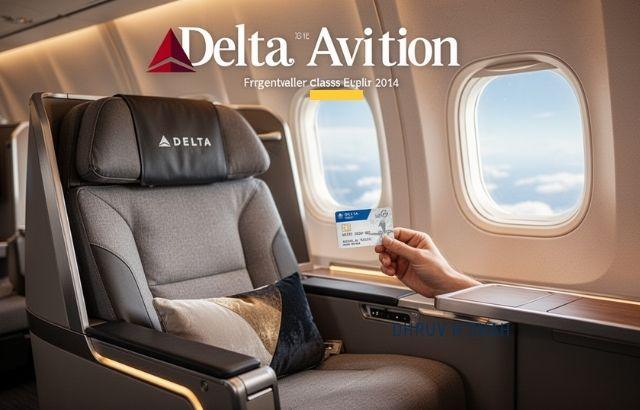
Delta Air Lines trades at a valuation discount to both its intrinsic DCF value and historical peer multiples, despite superior premium revenue mix and improving financial leverage. The company is positioned to deliver 10%+ EPS CAGR over the next four years as operating leverage, premium mix shift, and capacity discipline support margin expansion to 10.5%+. At 5.1x LTM and 6.4x NTM EV/EBITDA, squarely in line with legacy peers despite better fundamentals, DAL offers an attractive entry point with 20% upside to fair value and meaningful upside optionality if premium revenue momentum or cost management exceeds expectations. Target Change
| Rating | BUY |
| Price (17 Jan 2026) | $70.43 |
| Price Target | % To PT | $85 | ↑+20.6% |
| Market Cap | $45.7 B |
| Ticker | DAL |
Key Pillars of the Thesis
- Structural margin expansion driven by premium mix and operating leverage. Premium cabin revenue is now 25%+ of mainline revenue and growing 7%+ annually, while main cabin faces structural headwinds, shifting EBIT margins toward 10.5%+ by 2028 from 9.2% today.
- Healthy free cash flow supporting debt reduction and balance sheet repair. Delta generated $4.6B FCF in 2025 and is on track to deliver $3–4B annually, providing ample capacity to reduce net debt below $12B while maintaining CapEx discipline.
- Attractive relative and absolute valuation with meaningful upside. DCF-implied fair value of $85 rests on conservative assumptions (8.5% WACC, 2.75% terminal growth), and peer multiples suggest only modest premium to UAL/AAL despite better mix and balance sheet quality.
Key Catalysts (Next 12 Months)
- Q1/Q2 2026 earnings: Validate 20% full-year EPS growth guidance and confirm premium demand resilience. Watch for YoY comps on premium revenue and loyalty growth.
- Debt reduction progress: Track management commentary on path to $12–13B net debt target; $3–4B annual reduction is achievable with current cash generation.
- International capacity expansion: Fleet deployment decisions for new 787s and A350s will signal management confidence in transatlantic and Asia-Pacific premium demand.
- Potential dividend / buyback announcement: If leverage targets are met ahead of schedule, management may signal return of capital, re-rating the stock.
Business Overview
Company Profile
Delta Air Lines is the world’s largest airline by fleet size, operating approximately 900 mainline aircraft and serving 350+ destinations across six continents. The company’s revenue streams include:
- Mainline passenger revenue (~60%): Domestic and international flights across premium cabins, main deck, and basic economy
- Regional partner revenue (~8%): SkyWest and other codeshare partners
- Cargo (~4%): Dedicated freight capacity and belly cargo
- Loyalty & co-brand credit card (~13%): American Express partnership generating high-margin revenue
- MRO and other services (~7%): Aircraft maintenance, ground services, other ancillary fees
Recent Financial Results (FY 2025)
Delta closed 2025 with strong execution, delivering record operating cash flow and demonstrating the durability of its premium-focused model:
- Operating revenue: $63.4B (+2.8% YoY, despite government shutdown impact of ~$200M)
- Operating income: $5.8B (9.2% margin)
- Net income: $4.96B
- Diluted EPS (GAAP): $7.66; (adjusted): $5.82
- Operating cash flow: $8.3B
- Free cash flow: $4.6B
- Total debt: $14.1B (down $3.7B from 2024)
- Adjusted debt-to-EBITDAR:4x
Despite the late-December government shutdown hitting domestic capacity and revenue, premium revenue grew 7% and loyalty revenue grew approximately 6% year-over-year, underscoring resilience in high-yield segments.
2026 Outlook & Guidance
Management has guided for approximately 20% EPS growth in 2026 on an adjusted basis, with operating margin expansion continuing as premiumization and cost discipline take hold. Key forward expectations:
- Premium demand: Continued double-digit growth in premium cabin revenue as high-income consumers and corporate travel remain robust
- Capacity discipline: No major domestic capacity additions; focus on deploying new widebody aircraft (787, A350) on profitable international and long-haul routes
- Debt reduction: Target of $3–4B in debt paydown in 2026, bringing leverage toward 2.0–2.2x adjusted EBITDAR
- Fuel headwind/tailwind: Limited guidance, but IATA forecasts Brent crude averaging $62/bbl in 2026 vs. $56/bbl in 2025, a modest headwind offset by stable refining margins
Investment Thesis
1. Structural Margin Expansion Driven by Premium Mix Shift
Over the past 18 months, Delta has experienced a historic shift in revenue composition. Premium cabins and loyalty now represent the company’s fastest-growing and highest-margin revenue streams:
- Premium cabin revenue: Up 7% in FY 2025; now ~25% of mainline revenue
- Main cabin revenue: Down 7% in FY 2025, reflecting bifurcated consumer behavior
- Loyalty revenue: Up 6%, benefiting from higher spend-per-member and increased card-issuer volumes
- Mix effect: The combination of these trends supports EBIT margins expanding from 9.2% (2025) to 10.5%+ (2028–2030)
This is not a temporary phenomenon. The premium mix shift reflects deeper structural changes: (i) increased corporate travel and higher spend by wealthy consumers; (ii) Delta’s success in modernizing its premium product (new lie-flat seats, upgraded catering, lounge experience); and (iii) capacity constraints that prevent competitors from aggressive low-cost capacity additions. Your DCF incorporates gradual margin expansion to 10.5% by 2028, a conservative step-up from 9.2% that leaves room for upside if premiumization accelerates.
2. Attractive Free Cash Flow Yield and Debt Reduction Path
Delta is a cash machine. The company generated $4.6B of free cash flow in 2025, a 7.3% FCF yield on today’s $62.7B enterprise value, and is positioned to sustain $3–4B annually through the cycle. Capital allocation priorities are clear:
- CapEx: ~$5.5B annually through 2026–2027, moderating to ~$3.5–4B by 2030 as fleet modernization (737 MAX, 787, A350 conversions) largely completes
- Debt reduction: $3–4B per year targeting total debt below $12–13B by 2028, reducing adjusted EBITDAR below 2.0x
- Shareholder returns: Optionality for reinstatement of dividend and/or share repurchases once leverage reaches target levels
At a 6.4x NTM EV/EBITDA, the market is not fully valuing the cash generative power and financial flexibility implied by these FCF streams. For context, business services and industrials companies with similar FCF yields and balance sheet quality typically trade at 10–12x forward EBITDA.
3. Favorable Industry Dynamics and Capacity Discipline
The airline industry enters 2026 with structural tailwinds absent cyclical downturns: IATA 2026 forecasts:
- Global passenger traffic growth of 4.9% (reaching 5.1B passengers)
- Industry net profit of approximately $41B on record revenue of ~$1.05T (3.9% net margin)
- Global load factor of 83.8%, near historically elevated levels
- Capacity growth constrained by: (i) Boeing 737 MAX/787 production scrutiny; (ii) Airbus delays; (iii) supply chain constraints
Delta-specific benefits:
- Largest fleet and most comprehensive network reduce vulnerability to regional capacity constraints
- Premium focus insulates from low-cost carrier (LCC) capacity wars
- Strong balance sheet and investment-grade credit profile enable earlier fleet replacement, improving relative unit economics
- Loyalty ecosystem creates switching costs and recurring revenue
This backdrop should allow DAL to sustain healthy unit revenues (yield + RASM) even as fuel and labor costs remain elevated, supporting the 3% revenue CAGR assumed in the DCF.
4. Valuation Offers Upside with Limited Downside Risk
The combination of a DCF fair value of $84.96, peer multiples suggesting only a modest premium despite superior mix, and strong FCF generation creates an asymmetric risk-reward: Upside drivers:
- If premium revenue growth accelerates to 10%+ (achievable given corporate recovery and loyalty growth), EBIT margins could reach 11%+ by 2027, supporting valuations above $100/share
- If debt reduction accelerates ahead of schedule, management could unlock shareholder value through accelerated buybacks
- M&A optionality if valuations remain suppressed relative to cash generation
Downside protection:
- Even under conservative assumptions (9.5% WACC, 1.75% terminal growth), intrinsic value is $61.23/share, only 13% below current price
- Strong FCF ($4.6B annually) and improving balance sheet (2.4x EBITDAR) provide cushion against moderate demand or margin shocks
- Capacity discipline and premium mix reduce exposure to commodity-like price competition
Valuation Analysis
Discounted Cash Flow (DCF) Summary
Key assumptions:
- 2025–2030 revenue CAGR: ~3.0% (reflecting 6.2% in 2024 moderating to 3% as capacity constraints ease)
- EBIT margin profile:2% (2025) → 10.0% (2027) → 10.5% (2028–2030)
- CapEx intensity:7% (2026) → 5.0% (2030), reflecting fleet modernization completion
- Terminal year FCF: $4.8B; terminal enterprise value ~$86B (7.8x exit EV/EBITDA)
- WACC:49% (10.52% cost of equity, 4.15% after-tax cost of debt; 68.1% equity weight)
Implied valuation:
- Enterprise value: $72.2B
- Less: Net debt: $17.1B
- Equity value: $55.1B
- Implied share price: $84.96
- Upside from $70.43: 6%
Sensitivity Analysis
The accompanying sensitivity table shows intrinsic values across a range of WACC (7.5–9.5%) and terminal growth assumptions (1.75–3.75%):
| WACC | 1.75% Growth | 2.25% Growth | 2.75% Growth | 3.25% Growth | 3.75% Growth |
| 7.5% | $85.31 | $94.49 | $105.60 | $119.33 | $136.72 |
| 8.0% | $77.44 | $85.01 | $94.02 | $104.93 | $118.41 |
| 8.5% | $70.99 | $77.32 | $84.75 | $93.60 | $104.31 |
| 9.0% | $65.66 | $71.01 | $77.23 | $84.53 | $93.21 |
| 9.5% | $61.23 | $65.81 | $71.07 | $77.17 | $84.34 |
Observations:
- Base case (8.5% WACC, 2.75% g): $84.75 per share
- At current price of $70.43, the stock sits in or just below the $65–71 range, suggesting fair value under conservative assumptions but material upside under base/bull scenarios
- Even under a stressed scenario (9.5% WACC, 1.75% g), intrinsic value reaches $61.23, providing modest downside cushion
Comparable Company Analysis
Delta trades near the center of the global airline peer set on both LTM and forward multiples, despite a superior business mix and balance sheet. Peer Valuation Multiples
| Company | Ticker | Price | EV (USD mm) | EV/Sales LTM | EV/EBITDA LTM | P/E LTM |
| United Airlines | UAL | 113.49 | 54,734.0 | 0.9x | 4.3x | 10.4x |
| American Airlines | AAL | 15.37 | 38,822.5 | 0.7x | 4.1x | 16.4x |
| Southwest Airlines | LUV | 43.12 | 24,539.7 | 0.9x | 5.9x | 68.2x |
| Alaska Air Group | ALK | 50.04 | 10,003.1 | 0.7x | 4.1x | 16.8x |
| Deutsche Lufthansa | LHA | 9.79 | 17,788.4 | 0.4x | 3.7x | 8.7x |
| Allegiant Travel | ALGT | 89.95 | 2,761.4 | 1.1x | 8.4x | 23.1x |
| Air France–KLM | AF | 12.64 | 15,957.9 | 0.4x | 2.7x | 6.7x |
| IAG | IAG | 5.51 | 31,577.5 | 0.8x | 3.6x | 5.2x |
| Median | 43.12 | 24539.7 | 0.8x | 4.1x | 10.8x | |
| Delta Air Lines | DAL | 70.43 | 62,747.6 | 1.0x | 5.1x | 10.8x |
Key observations:
- LTM metrics: DAL at 1.0x EV/Sales and 5.1x EV/EBITDA sits firmly in the peer band (0.4–1.5x sales; 2.7–8.4x EBITDA), appearing slightly expensive on sales but modestly discounted on EBITDA relative to UAL, LUV, and ALGT, which more broadly represent the LCC/ultra-LCC spectrum with worse margins.
- NTM metrics: At 6.40x forward EV/EBITDA and 9.80x forward P/E, DAL trades in line with UAL (6.05x / 8.96x) and below LUV (7.07x / 14.95x), the historical premium name in the group. This suggests the market is pricing in DAL’s margin expansion but not yet assigning a premium valuation.
- Implied re-rating: The $85 target suggests approximately 7.0–7.5x 2026E EV/EBITDA on the forecast with a modest 10–15% step-up from current forward multiples but below where LUV historically traded and consistent with normalized multiples for a mid-cycle airline with 10%+ margins.
Risk Analysis
Downside Risks
Macroeconomic slowdown and demand destruction: A material slowdown in U.S. GDP growth or weakening in corporate travel would pressure premium demand and yields. Airlines are highly leveraged to economic cycles; a recession could reduce demand 5–15% and compress margins 200–400 bps. Your model assumes stable premium demand; a 5% decline in premium revenue growth would reduce terminal EBIT margins by 50+ bps and lower fair value to approximately $75–78/share. Fuel price spike: While IATA projects crude at $62/bbl in 2026, geopolitical events (Middle East tensions, OPEC+ production cuts) could rapidly reverse this. A 20% spike in jet fuel prices would flow through to operating costs absent corresponding demand destruction or pricing; this would reduce 2026E FCF by $300–500M and fair value by $3–5/share. Labor cost inflation: Delta faces ongoing labor negotiations for ground and other union contracts. If new labor contracts result in wage inflation exceeding 3–4% annually, the company would struggle to offset through pricing and efficiency; this could compress margins by 25–50 bps annually. Your model assumes 2–3% annual wage inflation; each additional 1% costs ~$200M in annual operating income. Competitive capacity addition: If the FAA relaxes Boeing production scrutiny or Airbus accelerates deliveries, competitors could normalize capacity growth, eroding the favorable pricing environment. A reacceleration of industry capacity growth to 4%+ would pressure DAL’s CAGR assumption and unit revenues. Fleet/operational disruptions: Supply-chain constraints, Boeing or Airbus delivery delays, or major operational disruptions (labor actions, cyber incidents, extreme weather) could raise costs and damage Delta’s premium brand positioning, undermining the mix shift thesis. Extended disruptions could compress margins by 100+ bps.
Upside Risks
Better-than-expected premiumization: If premium cabin ASM growth accelerates to 8–10% annually (vs. base case ~5–6%) and premium yield remains firm, EBIT margins could reach 11–12% by 2027, supporting fair valuations above $100/share and enabling faster debt reduction and shareholder returns. Faster debt paydown and financial flexibility: If operating performance or asset sales accelerate debt reduction, management could pursue a buyback program at current depressed valuations, creating meaningful per-share accretion. Early achievement of 1.5–1.8x EBITDAR leverage could unlock $5–7/share of additional value. Loyalty / Amex partnership upside: The Delta-Amex partnership is an embedded recurring revenue stream. Accelerated growth in card issuance volumes or increased monetization of loyalty miles could contribute an additional $200–300M annually, supporting faster EPS growth.
Key Metrics & Financial Summary
Historical and Projected Financial Performance
| Metric | 2024A | 2025A | 2026E | 2027E | 2028E | 2029E | 2030E |
| Operating Revenue ($M) | 58,048 | 63,364 | 63,364 | 66,532 | 69,526 | 72,307 | 74,838 |
| Revenue Growth (%) | 14.8% | 6.2% | 2.8% | 5.0% | 4.5% | 4.0% | 3.5% |
| EBIT ($M) | 5,521 | 5,822 | 5,822 | 6,653 | 7,300 | 7,954 | 8,232 |
| EBIT Margin (%) | 9.5% | 9.2% | 9.2% | 10.0% | 10.5% | 11.0% | 11.0% |
| Net Income ($M) | 3,600 | 4,960 | 4,700 | 5,541 | 6,088 | 6,618 | 6,854 |
| EPS (Diluted, $) | 5.54 | 7.66 | 7.25 | 8.54 | 9.38 | 10.20 | 10.56 |
| FCF ($M) | 1,070 | 4,600 | 1,258 | 2,629 | 3,358 | 4,054 | 4,571 |
| Net Debt ($M) | 24,900 | 17,100 | 14,000 | 11,400 | 8,000 | 4,000 | 1,200 |
| EBITDAR / EBITDA | 3.2x | 2.4x | 2.3x | 2.0x | 1.7x | 1.4x | 1.2x |
Recommendation & Conclusion
Delta Air Lines presents an attractive opportunity for investors seeking exposure to an improving cyclical story backed by strong cash generation, improving financial quality, and attractive valuations. The combination of structural premiumization, capacity discipline, and financial leverage reduction creates a clear path to 10%+ earnings growth through 2028 and beyond. At $70.43, DAL trades below our $85 fair value target on both DCF and comps methodologies, offering 20% upside with a favorable risk-reward profile anchored by strong FCF generation and industry tailwinds. We recommend accumulation on any weakness toward $65–68 (providing a more attractive entry for longer-term investors) and maintenance of positions for existing shareholders. Rating: BUY Price Target: $85.00 Risk Rating: MEDIUM (airline sector volatility and macroeconomic sensitivity) Investment Horizon: 12 months
Appendix
Free Cash Flow Model Detailed Assumptions Revenue drivers:
- 2025–2026: 2.8% growth (modest recovery post-shutdown)
- 2027–2028: 5.0% growth (mix shift and capacity discipline)
- 2029–2030: 3.5%–4.0% growth (normalization toward GDP+ growth)
Profitability assumptions:
- Tax rate: 24.5% (stabilized federal corporate rate)
- D&A: 3.8%–3.9% of revenue (fleet modernization cycle completion)
- EBIT margins: 9.2% (2025) → 10.0% (2027) → 10.5% (2028–2030)
Working capital and CapEx:
- CapEx: 8.7% of revenue (2026) → 6.5% (2027) → 5.0% (2030)
- Change in NWC: Modest negative impact in early years (customer deposits); neutral by 2030
WACC Calculation
| Component | Value | Calculation |
| Risk-free rate | 4.19% | 10Y Treasury yield (current) |
| Beta | 1.15 | 5Y monthly vs. S&P 500 |
| Equity risk premium | 5.50% | Historical long-term average |
| Cost of equity (CAPM) | 10.52% | Rf + (B × ERP) = 4.19% + (1.15 × 5.50%) |
| Pre-tax cost of debt | 5.50% | Weighted average coupon on outstanding debt |
| Tax rate | 24.50% | Blended federal/state marginal rate |
| After-tax cost of debt | 4.15% | 5.50% × (1 – 24.5%) |
| Equity weight (market cap basis) | 68.13% | $45.7B / $67.1B total capital |
| Debt weight | 31.87% | $21.4B / $67.1B total capital |
| WACC | 8.49% | (10.52% × 68.13%) + (4.15% × 31.87%) |
REFERENCES [1] International Air Transport Association. (December 2025). “Airline Profitability Stabilizes with 3.9% Net Margin Expected in 2026.” IATA Economics Reports. https://www.iata.org [2] Delta Air Lines, Inc. (January 12, 2026). “Delta Air Lines Announces December Quarter and Full Year 2025 Financial Results.” Press release. https://ir.delta.com [3] Delta Air Lines, Inc. (January 13, 2026). CEO Commentary: “Premium Demand and Loyalty Momentum Propel Record 2025 Results.” Investor Conference. https://ir.delta.com [4] Reuters. (January 13, 2026). “Delta leans on premium travel demand with upbeat 2026 outlook.” https://www.reuters.com/business/ [5] Airways Magazine. (December 16, 2025). “IATA: Airlines Set for Record $41B Profit in 2026.” https://airwaysmag.com [6] Fortune. (January 13, 2026). “Delta sees wealthy high fliers leading to another record year.” https://fortune.com/2026/01/13/